# Understanding a Changing World
The Foreign Policy Association—a non-partisan not-for-profit—created "Great Decisions" to serve as a catalyst for developing an awareness, understanding, and informed opinion on U.S. foreign policy and global issues. Today, it is the country's largest world affairs discussion program taking place in libraries, schools, and community centers across the United States.
Each program at Jacksonville Public Library includes:
- A (roughly) 25-minute "Master Class" video on a topic
- A discussion, facilitated by local subject-matter expert
- Recommendations for pre-reading or further study
# 2026 Topics & Discussion Schedule
Every year, eight topics are chosen by a panel of experts. Register for the discussion program(s) that interest you by clicking the title for each topic. Or bookmark this page on our events calendar.
-
U.S.-China Relations
- with Richard Eason, Retired Foreign Service Officer
- 7 p.m. on Thursday, Jan. 22, at Pablo Creek Regional
-
The Future of Human Rights and International Law
- with Professor Darby Scott, Florida State University
- 7 p.m. on Tuesday, Jan. 27, live on Zoom
-
Multilateral Institutions in a Changing World Order
- with Dr. Will Miller, Embry-Riddle Aeronautical University
- 7 p.m. on Tuesday, Feb. 10, at Southeast Regional
-
Trump Tariffs and the Future of the World Economy
- with Patrick O'Reilly, Retired Foreign Service Officer & UNF Professor
- 7 p.m. on Tuesday, Feb. 17, at Webb Wesconnett Regional
-
Ruptured Alliances and the Risk of Nuclear Proliferation
- with Dr. Jasmine McNealy, University of Florida
- 7 p.m. on Thursday, Feb. 19, live on Zoom
-
U.S. Engagement of Africa
- with Dr. Will Miller, Embry-Riddle Aeronautical University
- 7 p.m. on Monday, Feb. 23, at Highlands Regional
-
Ukraine and the Future of European Security
- with Richard Reiter, Retired Foreign Service Officer & UNF Professor
- 7 p.m. on Thursday, March 5, at Webb Wesconnett Regional
-
America and the World: Trump 2.0 Foreign Policy
- with Patrick Connell, Retired Foreign Service Officer & UNF Professor
- 7 p.m. on Tuesday, March 10, at Southeast Regional
Meetings will be held from 7 - 8:30 p.m. live on Zoom or at the following locations:
- Charles Webb Wesconnett Regional Library, 6887 103rd St.
- Highlands Regional Library, 1826 Dunn Ave.
- Pablo Creek Regional Library, 13295 Beach Blvd.
- Southeast Regional Library, 10599 Deerwood Park Blvd.
Be the first to know about upcoming programs!
# 2026 Reading Recommendations
# U.S.-China Relations
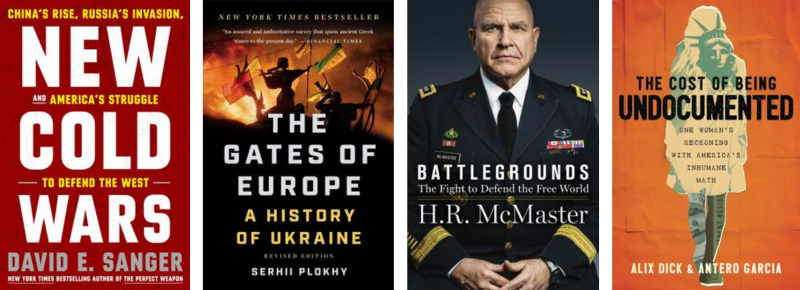
- New Cold Wars: China's Rise, Russia's Invasion, and America's Struggle to Defend the West by David Sanger
- The New China Playbook: Beyond Socialism and Capitalism by Keyu Jin
- Beijing Rules: How China Weaponized Its Economy to Confront the World by Bethany Allen
# The Future of Human Rights and International Law
- The Cost of Being Undocumented: One Women's Reckoning with America's Inhumane Math by Alix Dick
- Framed: Astonishing True Stories of Wrongful Convictions by John Grisham
- The New Breadline: Hunger and Hope in the Twenty-First Century by Jean-Martin Bauer
# Multilateral Institutions in a Changing World Order
- The Pandemic Pivot by John Feffer
- Navigating Uncertainty by Karoui Hichem
- Diplomatic Channels by Elias Thatcher Montague
# Trump Tariffs and the Future of the World Economy
- Chaos Under Heaven by Josh Rogin
- Chokepoints by Edward Fishman
- The Project by David Graham
# Ruptured Alliances and the Risk of Nuclear Proliferation
- The Myth of American Idealism: How U.S. Foreign Policy Endangers the World by Noam Chomsky
- Battlegrounds: The Fight to Defend the Free World by H.R. McMaster
- Countdown: The Blinding Future of Nuclear Weapons by Sarah Scoles
# U.S. Engagement of Africa
- Two Markets, Two Resources: Documenting China's Engagement in Africa by Emily de La Bruyere
- Reclaiming the Jewel of Africa by Olusegun Aganga
- The Looting Machine: Warlords, Oligarchs, Corporations, Smugglers, and the Theft of Africa's Wealth by Tom Burgis
# Ukraine and the Future of European Society
- The Gates of Europe: A History of Ukraine by Serhii Plokhy
- Red Famine: Stalin’s War on Ukraine by Anne Applebaum
- The Russo-Ukrainian War: The Return of History by Serhii Plokhy
# America and the World: Trump 2.0 Foreign Policy
- America Last: The Right's Century-Long Romance with Foreign Dictators by Jacob Heilbrunn
- The Folly of Realism: How the West Deceived Itself about Russia and Betrayed Ukraine by Alexander Vindman
- After the Fall: Being American in the World We've Made by Benjamin Rhodes
# How to Access Videos and the Companion Book
Though it is not necessary for participation in this free program at your Library, a companion book to the series is available for purchase (for $35) from the Foreign Policy Association. If you would like to re-watch videos shown during the program, you can also purchase streaming editions of the Master Class video series or the DVD, with all eight 25-minute class lectures, for $40 from their online bookstore.
"Master Class" videos are presented by Jeffrey S. Morton, the Pierrepont Comfort Chair in Political Science at Florida Atlantic University, and a Fellow at the Foreign Policy Association. He holds a Ph.D. in International Relations from the University of South Carolina and an M.A. from Rutgers University. Dr. Morton has delivered the Great Decisions program to live audiences since 1999.
# Sharing the Informed Opinions of Citizens for 70+ Years
The first "Great Decisions" group was launched in Portland, Oregon, in 1954 by the Foreign Policy Association's Vice President, Roger Mastrude. Based on the so-called "Avon" model of face-to-face, active, and informal conversation, participants would read a fact sheet on each of the eight topics before meetings, where they then aired their respective views and opinions. FPA would tally up opinion ballots and report the results to the Department of State.
The grassroots, face-to-face model adopted by Great Decisions more than 70 years ago continues today, providing background information and policy options on eight issues, chosen by a panel of experts. With tens of thousands of participants annually taking part in discussions nationwide, it strives to help communities and their leaders prepare for an increasingly interconnected world.
Participants may be polled about their views on the topics discussed. The results are compiled in the National Opinion Ballot Report and distributed to the White House, members of Congress, the departments of State and Defense, the national media and other participants. It is a valuable way of sharing the informed opinions of citizens with the people who shape U.S. foreign policy.